You have painted over the damp patch twice, and it keeps coming back. Or water is dripping from a crack right now, and no coating will stick to a wet wall.
This is where PU injection grouting comes in. It stops leaks from inside the crack itself, even when water is flowing. In this guide, you will learn what it is, how it works, and the situations where it is often the only option that works.
Quick Answer: What Is PU Injection Grouting?
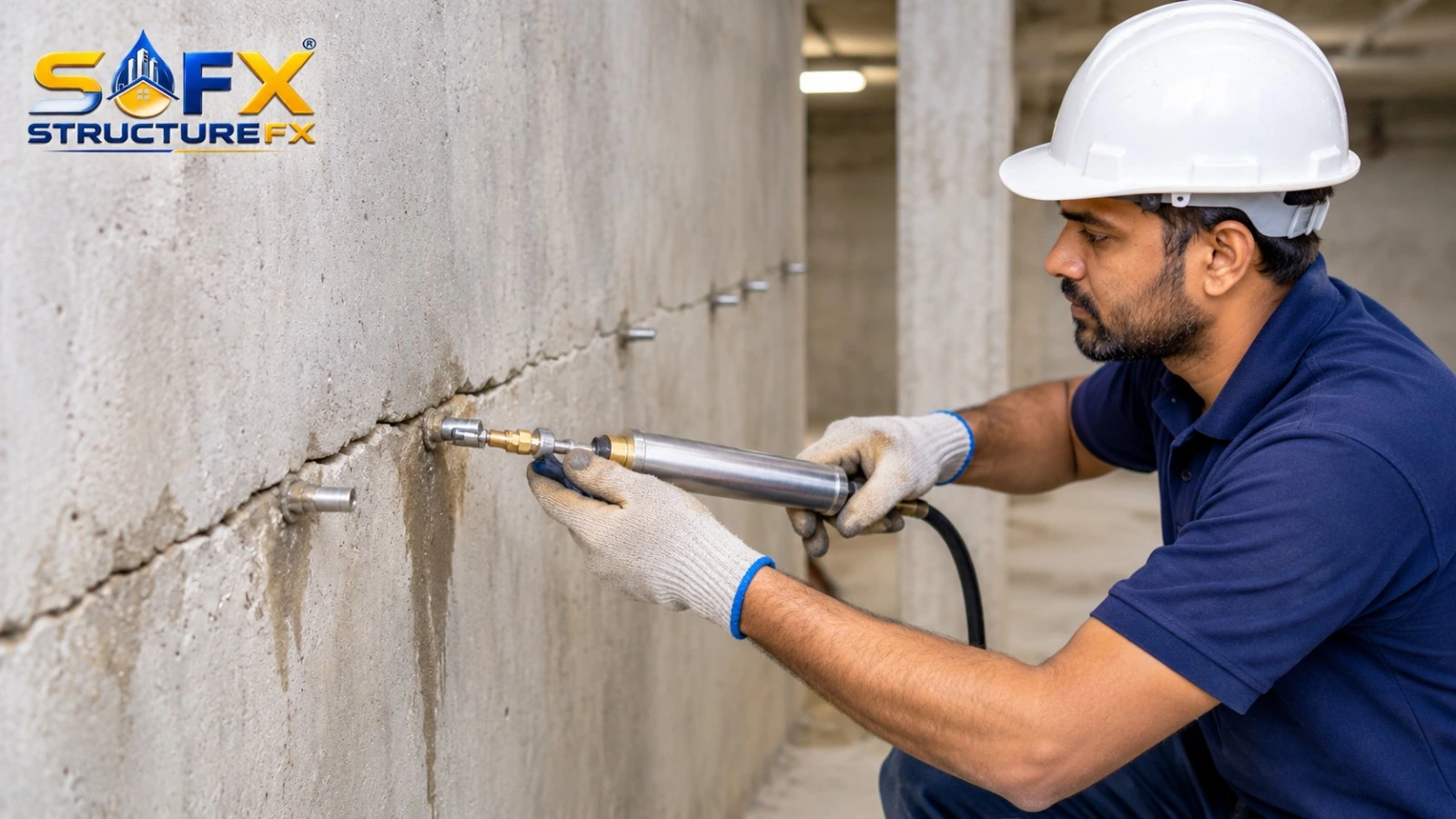
PU injection grouting is a leak-sealing method. A liquid polyurethane (PU) resin is pushed into a crack, joint or gap under low pressure. It reacts with water, expands, and seals the path the water was using.
It is mostly used for active leaks and cracks in basements, tanks, retaining walls, joints and slabs, where surface coatings alone cannot work.
What Is PU Injection Grouting in Simple Words?
“Grout” is just a sealing material that fills gaps. In PU injection grouting, the sealing material is polyurethane, a flexible resin that turns into foam or gel when it touches water.
Think of it like filling a leaking pipe from inside. Instead of covering the wet surface, you fill the crack so water has nowhere to travel.
How Does PU Injection Work?
PU resin is water-reactive. When it meets moisture inside the crack, it expands and hardens, blocking the leak. Two main types are used.
Foam-type (hydrophobic) PU
This type expands into a foam when it meets water. It is used to stop strong, flowing leaks quickly.
Gel-type (hydrophilic) PU
This type forms a soft, flexible gel that stays elastic. It is used for fine cracks, damp areas and joints that may move slightly.
A trained team picks the type based on how much water is coming through and how the crack behaves.
When Is PU Injection the Only Option?
In many cases, other methods can work. But in these situations, PU injection is often the only practical fix.
Water Is Flowing Right Now
Coatings and sealants cannot bond to a wet surface. If water is actively leaking, the crack must be sealed first. PU resin is made to work in the presence of water, which is why it can stop a live leak.
The Leak Is in a Basement or Below-Ground Wall
In basements, the water comes from the soil on the outside. You cannot dig around the building to reach it. Injection seals the leak from the inside, through the crack, without any excavation.
The Crack Moves
Some cracks open and close slightly with temperature or vibration. A hard filler or rigid coating would crack again. Flexible PU stays elastic and moves with the crack.
Leaks at Joints and Pipe Entries
Water often enters where pipes pass through walls or slabs, and at joints between two concrete pours. These spots are hard to coat. Injection fills the gap precisely.
You Cannot Wait for the Surface to Dry
During the monsoon, walls stay wet for days. Waiting for them to dry delays the repair while damage spreads. Injection can be done on a wet surface.
Breaking the Structure Costs Too Much
Chipping out walls or slabs to reach a leak is messy and can weaken the structure. Injection needs only small drill holes, so the surrounding area stays largely intact.
When PU Injection Is Not the Right Fix
Being honest here matters. PU injection is not a cure for everything.
- Wide damp areas: If a whole wall or terrace is seeping, a surface system like a coating or crystalline treatment is usually the better answer. See our guide on crystalline vs membrane waterproofing .
- An ageing terrace surface: A roof with a worn-out coat needs a new waterproofing layer, not injection alone.
- Structural cracks that are widening: If a crack keeps growing, the cause may be structural. A structural engineer should check it first.
- Dry structural cracks that need strength: Rigid, bonding materials like epoxy are better suited to restoring strength in dry cracks.
How PU Injection Grouting Is Done: Step by Step
- Find the leak. The team traces the crack or joint and marks the path.
- Drill small holes. Holes are drilled along the crack, angled so they cross it.
- Fix injection packers. Small fittings called packers are placed in the holes.
- Flush with water. This cleans the crack and helps the resin react.
- Inject the resin. PU is pumped in under low pressure, filling the crack from one end to the other.
- Wait and check. The resin expands and cures, and the team checks that the leak has stopped.
- Remove packers and finish. Holes are sealed, and the surface is repaired or coated as needed.
A small area can often be done in a day, though it depends on the extent of the leak and the surface.
Signs You May Need PU Injection
- Water dripping or seeping through a crack that keeps coming back
- Wet patches on a basement wall or floor, even after treating the surface
- Leaks around pipes, joints or the base of walls
- Damp patches that return after repainting
- A leak that gets worse during monsoon
- Water coming through a slab or retaining wall
If you notice these signs, an inspection will show whether injection is the right fix. Many of these problems also show up near terraces, so these signs your terrace needs waterproofing before the monsoon are worth a look.
Not Sure If It Needs Injection?
Book a free site inspection with Structure Fx Waterproofing, Panchkula. We will trace the leak and tell you honestly what it needs.
What Affects the Cost and Time
PU injection is often priced by the length of the crack or the number of injection points. A few things change the final figure:
- Length and number of cracks or joints
- How much water is flowing
- Access to the area, such as basements and tight spaces
- The material used, foam or gel, and the brand
- Extra work, such as surface coating or repainting afterwards
The only reliable way to know is to inspect the leak first. Anyone quoting a fixed price on the phone is guessing.
Questions to Ask a Contractor Before PU Injection
- Have you inspected the leak and found where the water is coming from?
- Which PU material will you use, and why that type?
- Will you inject low-pressure and test after?
- What is covered by the warranty, and for how long?
- Will you treat the larger surface afterwards if needed?
A good team will explain these clearly and tell you honestly if injection is not what you need.
How Structure Fx Handles PU Injection
At Structure Fx Waterproofing, PU injection grouting is part of our leak repair work, along with surface systems such as crystalline coatings and membranes. That means we are not forced to use injection for everything, and we are not limited to coatings when injection is the only fix.
Our process is simple:
- Free site inspection. We trace the leak and check its cause.
- Honest recommendation. We tell you whether you need injection, a surface system, or both.
- Clear written quote. It names the work and the materials.
- Warranty in writing and a final check after the work.
We use materials from trusted brands such as Dr. Fixit, Sika and Fosroc, and have been protecting homes, offices and housing societies across Panchkula and the Tricity since 2001.
FAQs: PU Injection Grouting
What is PU injection grouting used for?
It is used to stop active leaks and seal cracks, joints and gaps in basements, tanks, retaining walls, slabs and walls.
Can PU injection be done when water is leaking?
Yes. That is one of its main strengths. PU resin reacts with water and expands to seal the leak, so the surface does not need to be dry.
Is PU injection permanent?
It gives a long-lasting seal when done properly on the right problem. The result depends on the cause of the leak, the material and the workmanship.
Is PU injection better than epoxy injection?
They do different jobs. PU is flexible and works on wet and moving cracks. Epoxy is rigid and suits dry cracks that need strength.
Do I need to break the wall for PU injection?
No. The work needs only small drill holes along the crack, so there is little damage to the surrounding area.
How do I know if my leak needs PU injection?
If water keeps returning through a crack, joint or pipe point despite coatings, injection is likely. An inspection will confirm it.
Fix the Leak, Not Just the Wall
If a leak keeps coming back, the problem is probably not on the surface. Book a free site inspection with Structure Fx Waterproofing. Call +91-9517 756 631 or message us on WhatsApp, and we will find the source and tell you whether PU injection is the right fix.

Structure Fx Team
Waterproofing experts in Panchkula since 2001, trusted by 128+ happy customers across the Tricity.