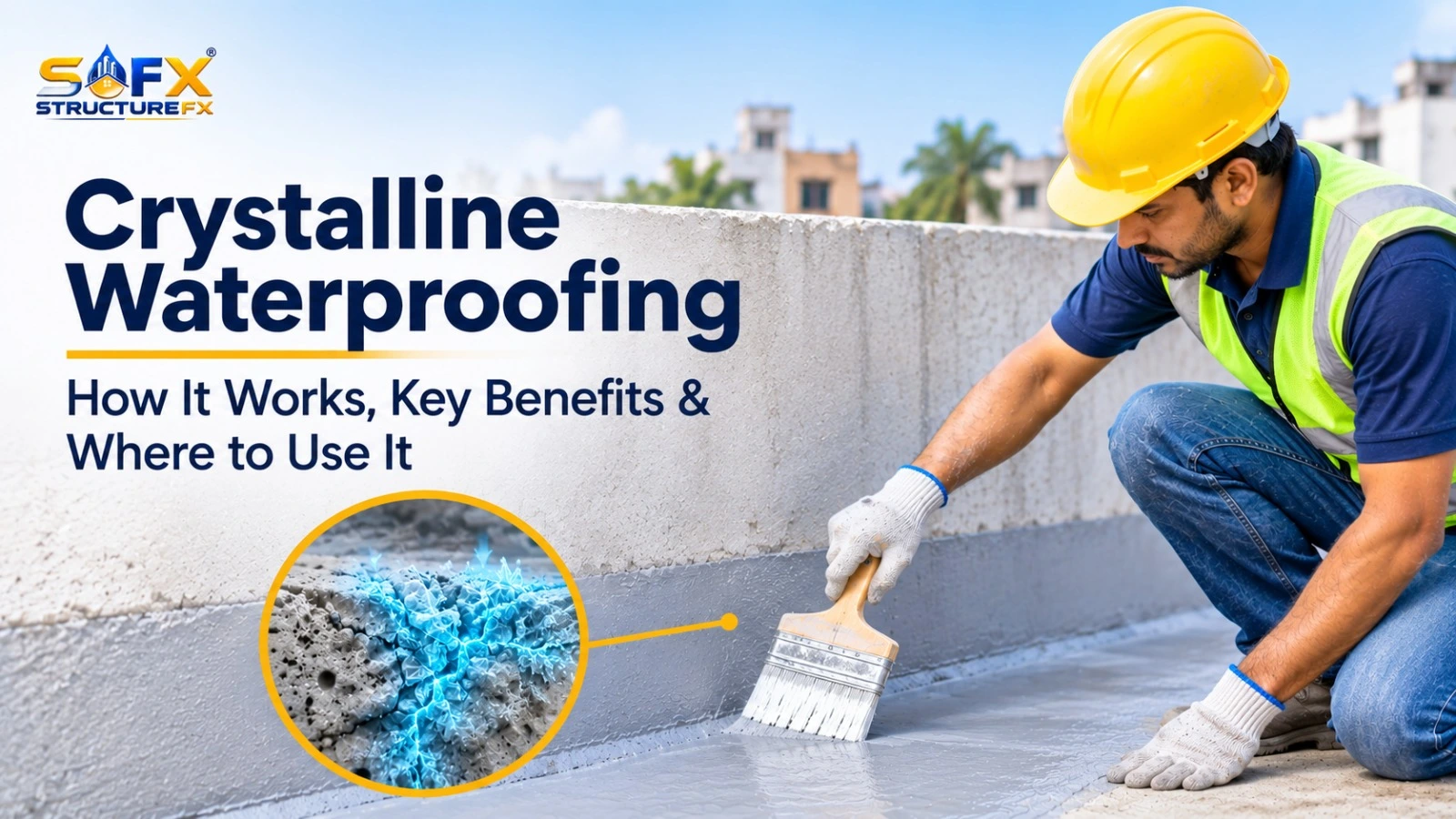
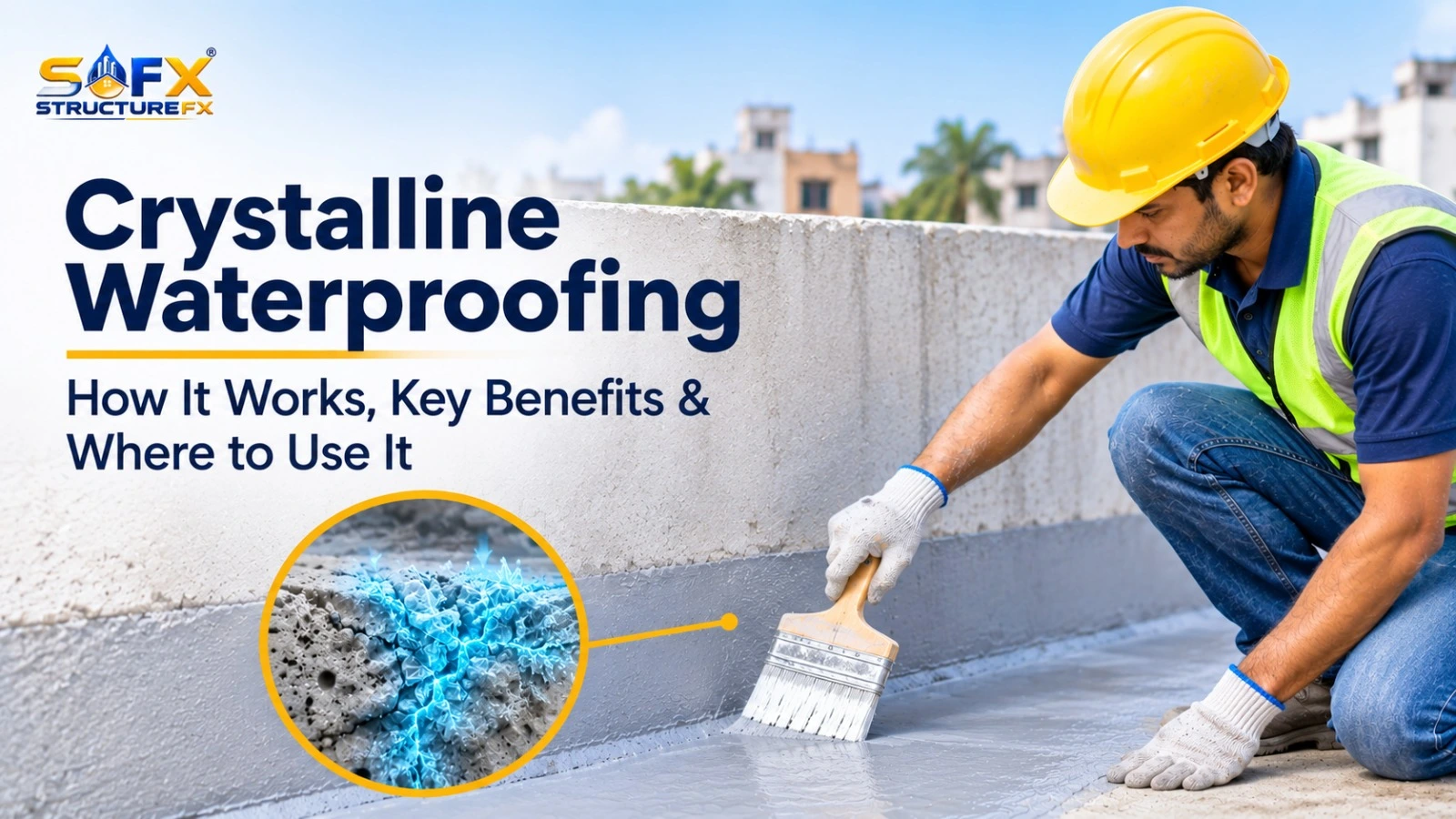
Most waterproofing sits on top of a surface, like a coat of paint. Crystalline waterproofing works differently. It goes inside the concrete and blocks water from within.
That is why it is a popular choice for basements, water tanks and other places where water pushes hard against the wall. In this guide, you will learn what crystalline waterproofing is, how it works, its main benefits and where it works best, along with the places where it does not.
Quick Answer: What Is Crystalline Waterproofing?
Crystalline waterproofing is a cement-based treatment that seals concrete from the inside. Special chemicals in the product react with water and the concrete itself to grow tiny crystals. These crystals fill the small pores and hairline cracks in the concrete, so water cannot pass through.
It is mostly used on below-ground and water-holding structures like basements, retaining walls, tanks and pits.
What Is Crystalline Waterproofing in Simple Words?
Concrete looks solid, but it is full of tiny holes and channels that water can travel through. Crystalline waterproofing fills those channels.
Think of it like a sponge. A normal coating covers the outside of the sponge. Crystalline waterproofing fills the sponge from within, so it stops soaking up water.
How Does Crystalline Waterproofing Work?
The process is simple once you know the basics.
- The product is applied. It is brushed onto damp concrete as a slurry, or mixed into the concrete when it is made.
- Water carries the active chemicals in. Water in the concrete moves these chemicals deep into the pores and tiny cracks.
- Crystals grow. The chemicals react with the leftover minerals in the concrete and form needle-like crystals. These crystals grow and fill the gaps.
- Water is blocked. Once the pores are filled, water cannot travel through. The crystals become a permanent part of the concrete.
It can also reactivate
If new hairline cracks form later and water enters, the leftover chemicals can react again and grow more crystals. This is why it is often described as self-sealing for fine cracks.
Three Ways Crystalline Waterproofing Is Used
- Slurry coat: a paste brushed or sprayed onto the surface of existing concrete. This is the most common method for repair and for finished buildings.
- Admixture: the product is added to the concrete mix during construction, so the whole slab or wall becomes water-resistant.
- Dry shake: a powder is spread on fresh concrete floors and worked in while the surface is still wet.
Key Benefits of Crystalline Waterproofing
Works From Inside the Concrete
Because it becomes part of the concrete, it cannot peel, bubble or tear away like a surface coat can.
Works Against Water Pressure
It can resist water pushing from the soil or from inside a tank. It can be applied on either side of the wall, even on the inside of a basement where the water comes from outside.
Long-Lasting
The crystals stay in the concrete as long as the concrete lasts, which is why it suits places that are hard to reach and repair again.
Lets the Wall Breathe
It blocks liquid water but still lets water vapour pass. This helps walls dry out instead of trapping moisture.
Safe for Water Tanks
Many crystalline products are made for potable-water use. Always check that the specific product is approved for drinking water.
Can Seal Fine Cracks Over Time
Fine hairline cracks that open later can often heal themselves when water reaches the leftover chemicals.
Fewer Extra Layers Needed
Unlike membranes, crystalline systems usually do not need a protective screed on top, which can save time and cost.
Where to Use Crystalline Waterproofing
It performs best on concrete and masonry that stay under water pressure or stay damp.
- Basements: damp walls and floors, from the inside or outside
- Retaining walls: walls that hold back soil
- Water tanks: underground and overhead tanks, with a potable-approved product
- Swimming pools: pool shells and balance tanks
- Lift pits and sump pits: places that sit below ground level and collect water
- Foundations and footings: when applied during construction
- Underground parking: floors and walls that show seepage
- Sewage and water treatment tanks: concrete tanks that stay wet all year
Where Crystalline Waterproofing Is Not the Best Choice
Every method has limits. Being clear about them avoids wasted money.
- Exposed terraces and roofs: These expand and contract with heat and cold. A flexible coating or membrane suits them better. Our guide on crystalline vs membrane waterproofing explains the difference.
- Moving or wide cracks: Crystals fill hairline cracks, not wide or moving ones. These need injection or a flexible repair.
- Water flowing right now: A strong active leak must be plugged or injected first. Our guide to PU injection grouting covers this.
- Non-concrete surfaces: It needs a porous, cement-based surface. It does not bond to tiles, paint or metal.
Protect Your Concrete From the Inside
Damp basement or leaking tank? Book a free site inspection with Structure Fx Waterproofing, Panchkula.
How Crystalline Waterproofing Is Applied
The result depends heavily on the preparation.
- Clean the surface. Loose plaster, paint, oil and old coatings are removed so the pores are open.
- Repair cracks and holes. Larger defects are fixed first, and active leaks are plugged.
- Wet the surface. The concrete is saturated with water, because crystals need moisture to grow.
- Apply the slurry. The product is mixed as directed and brushed on in coats.
- Cure. The surface is kept damp for the period the manufacturer specifies, so the crystals form properly.
Common Mistakes to Avoid in Crystalline Waterproofing
- Applying on a dry or dusty surface, which blocks the product from entering the pores
- Wrong mix ratio, which weakens the result
- Skipping curing, so the crystals never form fully
- Using it on a moving surface, such as an exposed terrace
- Ignoring active leaks, which wash the product away
What Affects the Crystalline Waterproofing Cost
Pricing depends on a few things, not just the product:
- Area to be treated
- Condition of the concrete and how much repair is needed
- Number of coats and the type of system
- Access, such as tight basements and tanks
- Brand and product grade
A site inspection gives a real figure. A fixed quote over the phone usually misses the repair work.
Questions to Ask Before You Hire a Crystalline Waterproofing Contractor
- Which crystalline product will you use, and is it approved for my use (such as a drinking water tank)?
- How will you prepare the surface?
- How many coats, and what is the curing plan?
- How will you deal with active leaks or larger cracks first?
- What does the warranty cover, and for how long?
How Structure Fx Uses Crystalline Waterproofing
At Structure Fx Waterproofing, we use crystalline systems where they work best: basements, tanks, pits and other below-ground concrete. We work with trusted brands such as Kryton, along with Dr. Fixit, Sika and Fosroc, and pick the system that suits your structure.
Our process is simple:
- Free site inspection. We check the concrete and trace where the water is coming from.
- Honest recommendation. We tell you if crystalline, injection, a membrane, or a mix is right.
- Clear written quote. It names the product, the coats, and the work involved.
- Warranty in writing and a final check after the job.
We have been protecting homes, offices and housing societies across Panchkula, Chandigarh, Mohali and Zirakpur since 2001.
FAQs: Crystalline Waterproofing
What is crystalline waterproofing used for?
It is used to waterproof concrete in basements, retaining walls, water tanks, pools, lift pits and other below-ground structures.
How long does crystalline waterproofing last?
It becomes part of the concrete, so it can last as long as the concrete does when applied correctly. Ask for the written warranty period.
Can crystalline waterproofing be applied from the inside?
Yes. It can be applied on the inside of a basement wall even when the water comes from outside, which is a major advantage.
Is crystalline waterproofing safe for drinking water tanks?
Many products are approved for potable water, but not all. Always confirm this on the product's data sheet.
Can crystalline waterproofing stop an active leak?
Not by itself. Active leaks need to be plugged or injected first, and crystalline waterproofing is then applied for the wider area.
Is crystalline waterproofing better than a membrane?
They suit different places. Crystalline works well on below-ground and water-holding concrete, while membranes suit exposed surfaces that move, like terraces.
Protect Your Concrete From the Inside
If you have a damp basement, a leaking tank or seepage you cannot stop with coatings, crystalline waterproofing may be the answer. Book a free site inspection with Structure Fx Waterproofing. Call +91-9517 756 631 or message us on WhatsApp, and we will check your structure and recommend the right fix.

Structure Fx Team
Waterproofing experts in Panchkula since 2001, trusted by 128+ happy customers across the Tricity.